
What is Sveltia CMS?
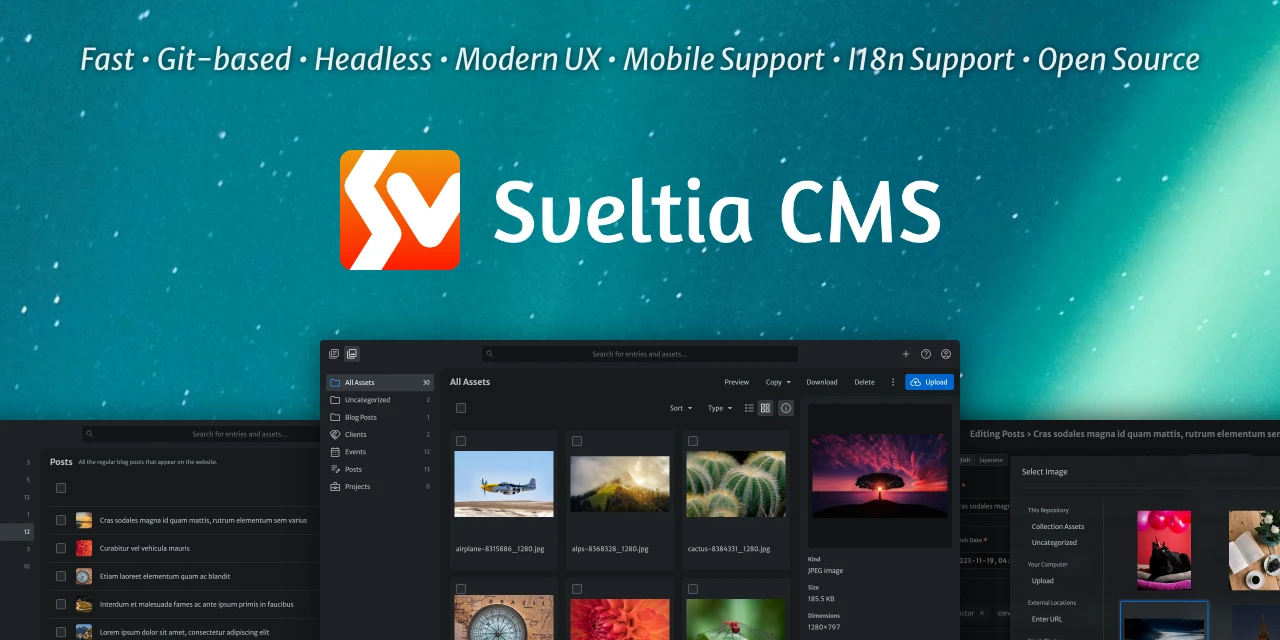
Sveltia CMS is a leading Git-based headless content management system designed for Jamstack web development. It’s open source and free for personal and commercial use. Our modern, lightweight CMS provides an excellent user experience (UX) for content editors and a great developer experience (DX) for web developers.
Sveltia CMS was specifically built as a successor to Netlify CMS (now Decap CMS), addressing its shortcomings and adding many new features, while maintaining compatibility with its configuration format, API and workflow. Migrating from Netlify/Decap CMS to Sveltia CMS is straightforward and requires minimal changes.
Try Sveltia CMS today and experience a fast, flexible, and user-friendly CMS that empowers you to manage your content with ease.
Highlights
While there are numerous CMS options available in the market, Sveltia CMS stands out due to its unique combination of features, architecture, performance, and user experience.
The unique selling points of Sveltia CMS include:
Git-Based
Content is stored in your Git repository, giving you full control, complete version history, and collaboration capabilities. No database is required. Every change is auditable.
Headless
Decoupled from the frontend, allowing you to use any static site generator (SSG) or frontend framework of your choice. Deploy anywhere. Perfect for Jamstack architecture.
Lightweight
It’s a single-page application (SPA) with less than 550 KB (minified + brotlied) for the entire CMS application, yet packed with many powerful features. A low-carbon footprint CMS.
High Performance
Built with the Svelte framework, Lexical editor, efficient GraphQL APIs, smart caching strategies, and lazy loading to ensure a fast and responsive user experience.
Maintenance-Free
The CMS is a small JavaScript bundle served via a content delivery network (CDN) and runs entirely in the browser. Always up-to-date. No build tools or servers required.
Not SaaS
It’s not a service but a client-side application, giving you full control over your data. No user registration or subscription required. NPM package is available for self-hosting.
Modern UX
An intuitive, user-friendly, and accessible UI for content editors, including 25+ languages, mobile support, dark mode, keyboard shortcuts, drag-and-drop uploads, and more.
Excellent DX
Developer experience is a top priority, with comprehensive documentation, JSON schema for configuration, TypeScript support, AI tools, and local development workflow.
Generic-Purpose
Designed to handle a wide range of content types and use cases, making it suitable for various projects — from blogs and portfolios to catalogs and knowledge bases.
No Vendor Lock-In
Framework-agnostic and platform-independent, with support for common file formats and multiple Git service providers. Bring your favorite tech stack. Switch services anytime.
First-Class I18n Support
Built-in support for multiple languages, making it easy to create multilingual websites. Translate content with one-click using AI integrations.
Powerful Asset Management
A built-in digital asset management (DAM) system for uploading and managing media files. Integrates with external storage and stock photo providers.
Open Source
Available under the permissive MIT license, allowing modification and commercial use. Fully transparent development process on GitHub. Free of charge, forever.
Privacy Focused
We don’t collect any user data. No account. No analytics. All operations occur directly between the browser and Git backend, as well as your chosen third-party integrations.
Active Development
Regular updates and improvements, with a focus on addressing user feedback and issues. Bug fixes typically released within 12 hours, and new features added frequently.
Successor to Netlify CMS
A modern, powerful, and user-friendly alternative to Netlify/Decap CMS, with a familiar configuration format, API and workflow. Easy migration path for existing users.
Trusted Platform
Maintained with great care by an experienced UX engineer. Praised by developers. Backed by hundreds of real-world examples, including U.S. government agencies.
Use Cases
Sveltia CMS is a generic-purpose content management system that can handle a wide variety of content types and use cases beyond just blog posts and pages.
It can be used in various scenarios, including:
- Personal blogs and websites
- Small business sites
- Community and organization sites
- Institutional and educational sites
- Nonprofit and charity sites
- Government and public sector sites
- Retail and e-commerce sites
- Artist and creative sites
- Blogs and news sites
- Marketing sites
- Documentation sites
- Portfolios and resumes
- Product catalogs
- Event listings
- Member directories
- Knowledge bases, glossaries and wikis
Take a look at the Showcase page for real-world examples of websites using Sveltia CMS across different industries and purposes.
Migrating from Other CMSs
Sveltia CMS is a modern, powerful, and user-friendly successor to Netlify CMS (now Decap CMS). Many sites are switching from Netlify/Decap CMS to Sveltia CMS to enjoy its superior features, performance, and user experience.
CMS migrations are more common than you might think, and Sveltia CMS is a popular choice for those looking to move away from other platforms. In fact, around 60% of Sveltia CMS users have migrated from other platforms, including:
- Our predecessor and its variants: Netlify CMS, Decap CMS, Static CMS
- Other headless CMSs: Pages CMS, DatoCMS, Keystatic, TinaCMS, etc.
- Traditional CMSs: WordPress, Joomla, Drupal, etc.
- Website builders: Wix, Squarespace, GoDaddy, Google Sites, Webflow, Weebly, etc.
Our industry-leading showcase tracks which sites have migrated from which platforms, so you can see how other users have successfully transitioned to Sveltia CMS.
Selling Products Online
Sveltia CMS isn’t an e-commerce platform, but some small online stores use it to manage their product catalogs and accept orders through a messaging app like WhatsApp. This is a great option for small businesses that want to sell products online without the complexity and cost of a full-fledged e-commerce solution.
See the Retail & E-commerce category on our Showcase for examples of retailers using Sveltia CMS.
Scalability
There are no hard limits on the amount of content or number of users you can have with Sveltia CMS. However, performance may vary depending on the size of your Git repository and your Git service provider’s capabilities.
The CMS is largely constrained by the API of the underlying Git backend: the number of files that can be fetched, created, updated, or deleted in a single API call, as well as rate limits, response times, and other factors. Among the supported backends, GitHub generally offers the best performance and reliability thanks to its powerful GraphQL API.
Due to these limitations, Git-based CMSs like Sveltia CMS are best suited for small to medium-sized projects. For large projects involving thousands of entries and assets, consider a more robust CMS solution designed for enterprise use.
Framework Agnosticism
Sveltia CMS is typically used to generate data that is then consumed by a frontend framework to build websites or web applications. It’s framework-agnostic, meaning it simply reads and writes data files without interacting with your chosen framework.
This flexibility extends far beyond traditional web projects. It can manage a JSON data catalog consumed by mobile apps or other software, or power vanilla JavaScript projects where webpages directly read static files. Whether you’re using a modern framework, no framework at all, or building entirely different types of applications, the CMS adapts to your needs.
At its core, Sveltia CMS is a simple NoSQL database management system that uses Git repositories as its data store. This design enables it to be adapted to various content management scenarios.
Target Audience
Git-based headless CMSs like Sveltia CMS are part of the larger Jamstack ecosystem. Setting up the CMS requires broad technical knowledge, such as familiarity with Git workflow, framework integration and CI/CD pipelines. Therefore, it’s primarily targeted at experienced web developers who have the necessary skills.
Of course, the CMS is not only aimed at individuals. It serves small to medium-sized businesses (SMBs), nonprofit organizations, and agencies with access to engineering resources for initial setup and ongoing maintenance. It is ideal for those who need a flexible, powerful and cost-effective CMS solution without vendor lock-in.
Once set up by developers, CMS end-users, such as content editors and marketers, don’t need any technical knowledge to use the application for content editing and management. The CMS hides all technical complexities behind a user-friendly interface.
No resources to set up and maintain a CMS? The maintainer is available for hire to help you get started. See the Support page for details.
Users require a Git service account
Currently, Sveltia CMS does not have a built-in user authentication system. Instead, it relies on the Git backend for user authentication and access control. This means that users need to have an account with the chosen Git service provider (e.g. GitHub) to access the CMS, though they don’t need to know Git itself or how to use the service. We plan to add better authentication methods in future releases to accommodate users without Git service accounts.
Great for Freelancers and Clients
Sveltia CMS was originally developed by a freelance UX engineer for his own clients, and he continues to maintain it. As such, it’s designed with the needs of freelancers and their clients in mind.
It’s ideal for freelance developers who want to provide their clients with a modern, powerful, user-friendly CMS solution without the hassle of setting up and maintaining a traditional CMS, such as WordPress. It’s also great for clients who want an intuitive interface for managing their content without worrying about technical details.
Why Choose Sveltia CMS?
If you’re specifically looking for a free, open source, Git-based headless CMS, your options are limited. Actively maintained, framework-agnostic offerings are especially rare, leaving Tina and Sveltia CMS as the primary choices.
Tina is a commercial entity that mainly caters to large-scale Next.js projects. In contrast, Sveltia CMS is a community-driven project that prioritizes excellent UX and DX for small to medium-sized projects using any framework, including Astro, Eleventy, Hugo, Jekyll and SvelteKit.
It’s also a successor to Netlify CMS (now Decap CMS), which has been widely used in the Jamstack community for years. Trying Sveltia CMS is a no-brainer if you’re looking for a modern, powerful, and user-friendly alternative to Netlify/Decap CMS.
Need i18n support? Sveltia CMS is the only option that offers first-class multilingual content management capabilities right out of the box.
Choose a well-maintained CMS
Most open source, Git-based CMS projects either become abandoned or are barely maintained. This includes Netlify CMS, Decap CMS, Static CMS, and Pages CMS, among others.
Users are left with unmaintained software that may contain security vulnerabilities, bugs, and compatibility issues. To ensure you receive timely updates and support, always choose a CMS that is actively maintained and has a responsive development team.
Who’s Using Sveltia CMS?
While there is no way to track all Sveltia CMS users due to its open source nature, we have seen a growing number of websites adopting Sveltia CMS since its launch. GitHub search suggests our product is already being used by thousands of projects, including personal blogs, community sites, institutional sites, and small business sites.
Our Showcase page features a curated selection of websites using Sveltia CMS across different industries and purposes. We encourage you to explore these examples to see the versatility and capabilities of Sveltia CMS in action.
We’ve shared some community insights based on the first 300 sites listed on the showcase. These insights give us a good idea of the types of projects and users that have adopted Sveltia CMS.
See also the homepage for testimonials from developers who have tried Sveltia CMS and shared their feedback.
Try It Online
A live demo site is coming soon!
Project Goals
- Making Sveltia CMS a viable, definitive successor to Netlify CMS
- Empowering SMBs and individuals who need a free, yet powerful, high-quality CMS solution
- Emerging as the leading open source offering in the Git-based CMS market
- Providing superior i18n support for multilingual content management
- Extending its capabilities as digital asset management (DAM) software
- Showcasing the power of Svelte and UX engineering
Project Status
Sveltia CMS is currently in beta, with version 1.0 (GA) scheduled for release in late 2026. Check our release notes for updates. See also our roadmap.
This is currently a personal project maintained by a single developer. We continue to create a robust successor to Netlify CMS and refactor the codebase for long-term maintainability, so our development pace may be slower than you expect. We’ll welcome contributions from the community once our codebase has stabilized.
About the Author
Sveltia CMS is created and maintained by Kohei Yoshino, a seasoned UX engineer based in Toronto, Canada. With over 20 years of experience in web development and open source, Kohei is passionate about building tools that improve people’s lives.
As a generalist who loves code, design, marketing, localization, documentation and everything in between, Kohei brings a unique perspective to software development. He is dedicated to creating high-quality, user-centric products that solve real-world problems.
Sveltia CMS is Kohei’s flagship open source project originally built for his own freelance clients, and he is committed to its long-term success and growth. You’re in good hands — Expect constant improvements to the UX and DX across the platform.
Resources
- Introducing Sveltia CMS: a short technical presentation by @kyoshino during the This Week in Svelte online meetup on March 31, 2023 — slides & recording
- Introducing Sveltia CMS: The Git-based Headless CMS Renaissance: a presentation by @kyoshino at the Build-Time Render online meetup on February 3, 2026 — slides & recording
External Recognition
- LogRocket Blog – 9 best Git-based CMS platforms for your next project
- Jamstack – Headless CMS
- Hugo – Front-end interfaces
- Made with Svelte
- 11ty Bundle Blog
Acknowledgments
This project would not have been possible without the open source Netlify CMS project. We are grateful to the maintainers for their hard work over the years. We would also like to thank the Sveltia CMS user community for their valuable feedback and ongoing support, which has helped us to identify issues and improve the product.
Additionally, we want to acknowledge the contributions of the many open source projects and libraries that Sveltia CMS relies on, including Svelte, Lexical, DOMPurify, and more. Finally, we want to thank you for taking the time to learn about Sveltia CMS. We hope it can be a valuable tool for your content management needs.